


Public art is not merely decoration—it is dialogue
December 09, 2025
Public art is not merely decoration—it is dialogue. It speaks to the people who pass by it every day, whether they pause to listen or not. It tells stories about who we are, what we value, and how we wish to see ourselves reflected in the built world. In this sense, public art functions as a form of collective storytelling—one that is democratic and evolving. It stands at the intersection of civic life and creative expression, challenging cities to be more than functional grids of concrete and commerce. Instead, through the presence of art, cities become living galleries—spaces where imagination and identity converge.
The History of Public Art
Public art has always been a powerful means of communication. Ancient Egyptians, Greeks, and Romans used monumental sculpture and architecture for both civic and religious purpose. Public art told stories to the masses, intimidated political rivals, and created unified cultural identities. Throughout the medieval period the Catholic church commissioned stained glass, frescoes, and sculpture to convey the grandeur and beauty of the church, and encourage religious devotion. Christian public art peaked in the Baroque period when the Catholic church fought to regain it’s authority following the Reformation. The use of public art to sway the minds and hearts of the people continued into the 20th century where Hilter’s Nazi Party commissioned public films and posters to disparage the Jews, Mexican Muralism’s public frescos promoted a revolutionary nationalist agenda, and mass produced public art bolstered the Chinese Cultural Revolution.
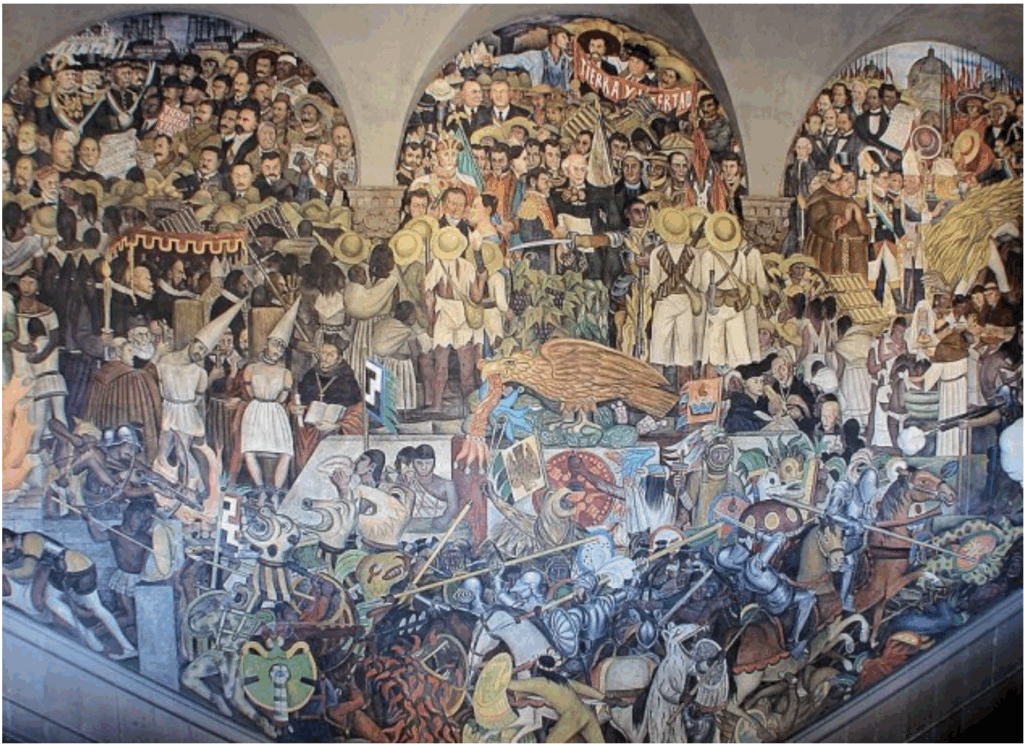
The History of Mexico, Diego Rivera, National Palace, Mexico City
Current, contemporary public art is considered by many to be more democratic than it’s predecessors. Whereas earlier public arts such as monuments and architectural projects were created for the public to view, they were not created for or with the public. More recent works are created with a wider array of funding sources such as; municipal funds, private developers, non-profits, art institutions, community fundraising, and local businesses. Diversified funding allows for more diverse messaging that is often more reflective of the communities in which the art resides. Defining the community in it’s own voice it transforms public spaces into places of connection and contemplation.
To this day a vital conversation continues around public art – and many questions remain unanswered: what history do we want to commemorate, who is represented, and what do we do with public monuments that no longer align with the values of the community? There are no definitive answers but the ongoing conversation is essential to understanding who we are, what we value, and who we want to be.
Erdman’s Public Sculpture
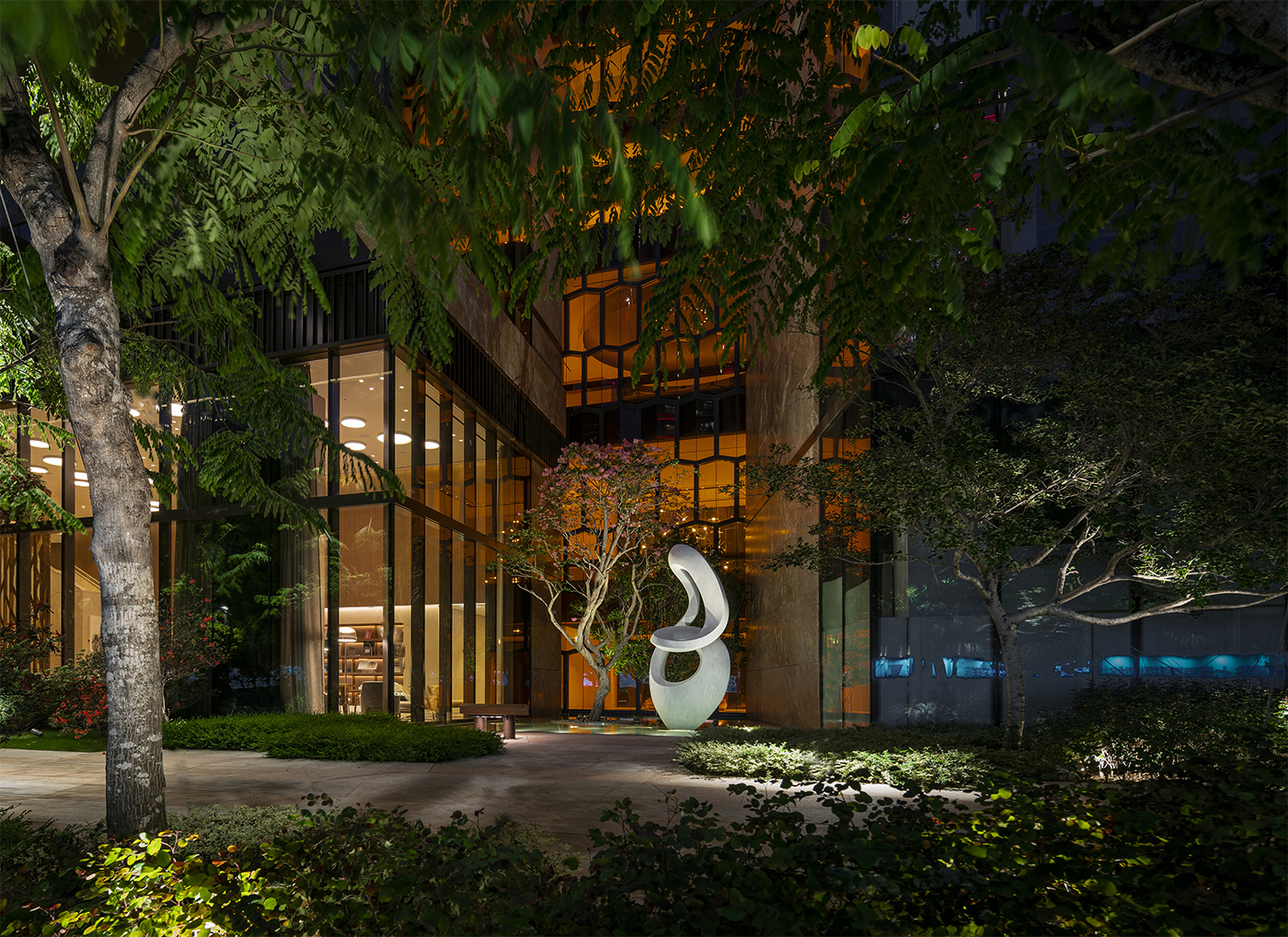
Richard Erdman’s sculptures exemplify the transformative power of public art. His monumental works—fluid, dynamic, and carved from enduring materials like marble and bronze—engage both the physical environment and the human spirit. Erdman’s abstract forms evoke motion, balance, and harmony, suggesting the natural forces that shape both landscape and life. Whether installed in a bustling city plaza or a serene courtyard, his sculptures invite viewers to pause and experience a sense of wonder.

Cities that host Erdman’s work benefit not only from the visual impact of his art but also from the deeper sense of vitality it brings to public space. His sculptures interact with light, weather, and the constant bustling movement of inhabitants, making each viewing unique and personal. The way light glides across a sculptures surface, or rain pools in it’s gentle folds, makes each sculpture a participant in its environment, a citizen of it’s community, constantly changing and renewing itself in conversation with the world around it.
In public contexts, this conversation becomes deeply civic. When one of Erdman’s works rises in a plaza or garden, it doesn’t just occupy space—it redefines it. What was once an empty walkway becomes a site of encounter. People gather, linger, and interact. The sculpture becomes a landmark, a point of orientation, a meeting place. It invites reflection without instruction, giving passersby the freedom to interpret its meaning for themselves. In a time when so much of urban life can feel transient and impersonal, Erdman’s work offers an antidote: a moment of stillness and connection, sculpted in stone.
Ultimately, Richard Erdman’s public sculptures exemplify how art in public spaces can elevate both the physical and emotional landscape of a city. Through their timelessness, energy, and accessibility, they remind us that art belongs not just in museums, but in the heart of everyday life. It is after all within the bustle of everyday life that we find ourselves and collectively the soul of our community.
Contact our Director Abbey Meaker at [email protected] with sculpture inquiries.